Thursday, May 30, 2013

Born on this day in 1927‏

My dad, Derek Lawson. Figure he is about 24 in this photo, has a wedding ring on, think this must be up at Pike Bay at his parent’s cottage sitting on the bumper of an old Plymouth. He would be 86 years old if he were still with us today. He’s been gone for 24 years and I still feel the ache in my heart and get all weepy when I think of him. A kind and gentle man, soft spoken and thoughtful, sincere, genuine. He was a wonderful father, a good person.

Wish he was here so I could give him a big hug, can still remember how wonderful that felt. Even just talking to him on the phone made me feel safe, like none of my problems really mattered.

Love you dad. Happy Birthday!

Always ... John

Tuesday, May 28, 2013

Somewhere Between the Two by Jay Little

Somewhere Between the Two by Jay Little

My rating: 3 of 5 stars

DOWNLOAD EBOOK HERE.

I read this book on the recommendation of Victor J. Banis in his autobiography Spine Intact, Some Creases.

I rather suspect Mr. Banis’ recommendation is based on memories of when he first read this book, published originally in 1956, than on a current reading. While it is, as Banis suggests, a behind the scenes tale of a female impersonator, in modern terms the book is far too focused on suicide and sad gay lives to really be able to focus on much else.

In addition to the sad gay lives, the author frequently lapses into verse so flowery it is nonsensical:
With whom would Terry taste of the scarlet fruit close to serpent waters?

The height of the nonsensical prose is during the few sex scenes:
Drowsily, not quite sure but that he might be dreaming, he watched the blurred vision in front of him, and when their ridged bodies contacted again in the night, the rose of love was blooming because they were both lonely and mortal. There could no longer be concealments and evasions. The life in which Bruce Sanger lived, floating like an island in oceanic dawn, had sent another wanderer to his shore of needs, boundaries, and events. It had come from no space and no time. It was as old as the world, and yet it was so mysterious and haunting as it wove its damp breath of memories over him.

They’re actually kind of funny, the author sometimes goes on for paragraphs about volcanoes and the crescent moon, etc.

I found the life of the female illusionist interestingly portrayed:
Each one created an illusion so close to reality that many in the audience gasped, "Do you mean to tell me that's a boy... really? You could fool me...." And that, to the impersonator, was more than adequate compensation for all the uncertainties and disappointments, rude remarks, corruptions, the anxieties and the heartaches and heartbreaks, with which their lives are beset.

I feel some of this may have been white-washed for the time period the book was written. There are maybe ten female impersonators in the troupe and only 2 are gay? They’re made to seem like straights are the norm in the business, and I don’t think that has ever been true.

The author talks of straight men coming on to the impersonators:
The animal scent within their loins was eager for new quests, an escape from the form of payment in installments called marriage.

So he doesn’t really make straight life sound great either. The gay life is played as darker than it was and the impersonator life is played lighter, so I don’t really trust the historical aspects of the book.

Also the melodrama really bubbles over the top in this one.

View all my reviews

Monday, May 27, 2013

Doors Open Toronto 2013

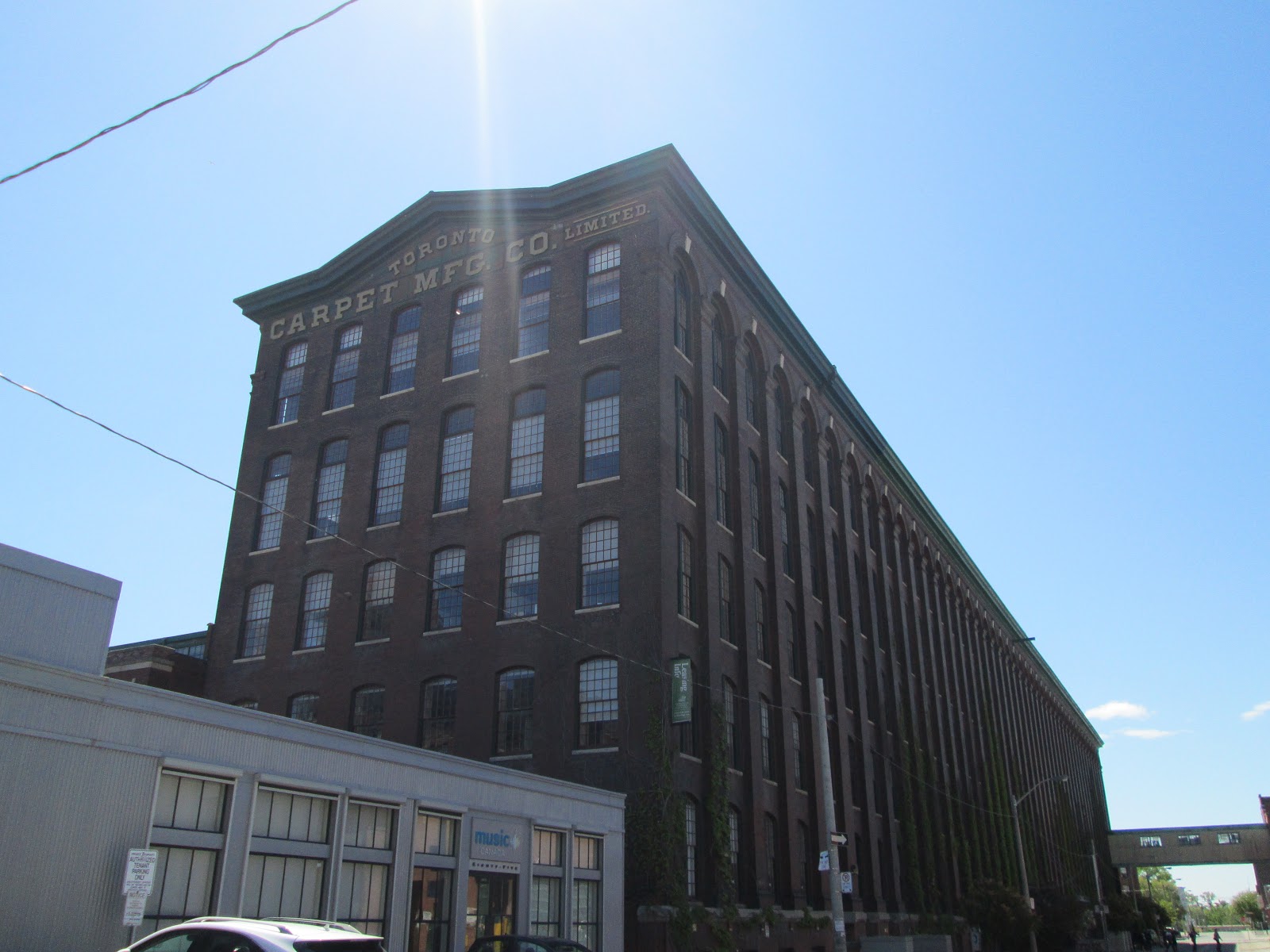
Doors open 2013 was fun.  Went with my mom to the building on the cover of the Star insert about the event, the Carpet Factory in Liberty Village.
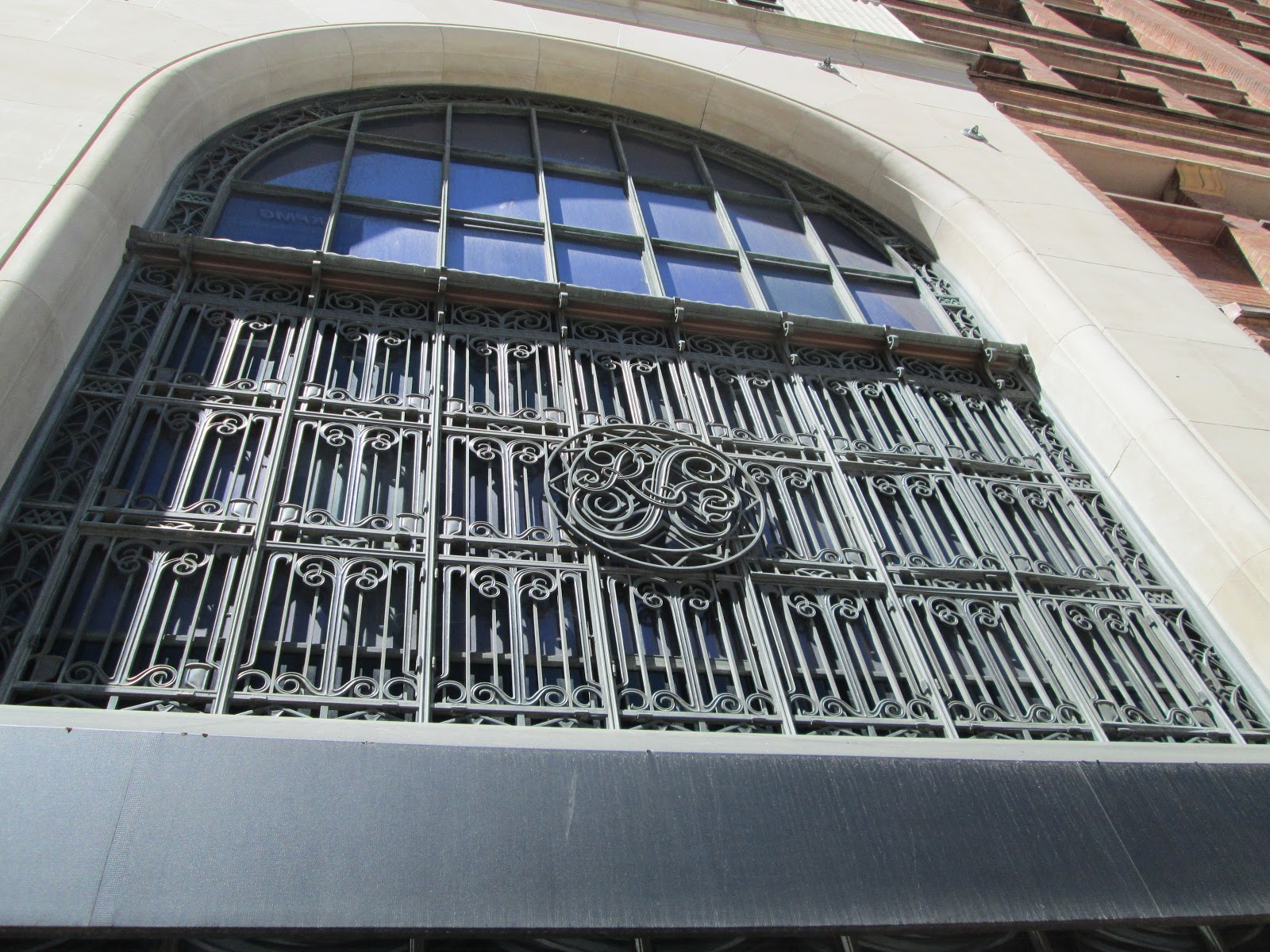
We had managed to secure tickets to the HBC Queen Street tour as well, which was great fun.  Originally all Yonge St fronted buildings had to be curved, like this example below.  The original HBC building burned down so they didn't build it the same the second time and got fines every year until they funded the onsite subway entrance.
Also note the small side street to the right of City Hall and behind the Eaton Centre used to extend south of Queen to Richmond.  It was purchased to extend Simpsons.
 The original Simpsons logo was above all entrances, and it still above some.
 An original and very dusty fire hose from the mid-50's.
 A lot of things we hidden by the stairs.  When the building was built there were many staircases, which were later replaced by escalators.  The disused stairwells now hold loads of treasures, like the fire hose above and the Simpsons sign below.
 We also went to Maple Leaf Gardens.  Here's a photo from long ago.
 And one from longer ago.
 They kept some of the original seats, which is great, but I think they will grow dusty.
 The new ice rink on the top floor.
 Some dashing mysterious lady came by the house to pay a visit.

Tuesday, May 21, 2013

Behind the Candelabra by Scott Thorson

Behind the Candelabra by Scott Thorson
My rating: 4 of 5 stars

This is a well-written book. Thorson and his ghost-writer did a great job.

The behind-the-scenes story of Liberace is captivating with lots of action and excess. I knew little about Liberace going in and this book serves as a great introduction to the man and his life.

Thorson starts the book off well, playing the narrator instead of choosing sides. Near the end, around 80%, that shifts heavily. Perhaps realizing the audience for the book would be Liberace’s fans, and not wanting to go up against a dying old man proved too much for him, as near the end I feel the claws really came out and it proved unnecessary.

It starts with Liberace’s pornography, of which Thorson says:
They all depicted homosexual acts and, even at the age of eighteen, I found the movies offensive and boring.

I have found in my life few times when things are both offensive and boring. They seem opposite emotions.

Thorson blames their relationship break-up jointly on Liberace’s pornography addiction and on his own drug addiction, although even the drug addiction he tries to blame on Liberace:
At first I tried to ignore the symptoms of his growing restlessness. When I couldn’t we usually wound up fighting. Then I’d take a little cocaine to help me over the rough spots. As the frequency of our arguments increased, so did my drug usage. With the wisdom of hindsight I realize that my drug habit caused some of the difficulty between us.

Thorson details a life spun out of control, culminating in him being holed up for two days doing drugs with a gun (!):
Angry; God, I’d never been so fucking angry! If Lee had made the mistake of walking in at that moment, I think I’d have killed him then and there.

And then two pages later says:
Meanwhile, Lee was back in Palm Springs, convinced that I now represented a serious danger to his health and happiness. He was scared to death. Of me!

The exclamation mark is what did it for me. You are out of control on drugs with a loaded gun, imagine him being afraid of that! Especially when you said you’d kill him two pages before. Thorson comes off badly in this section.

During their break-up, Thorson states:
Lee had his mind set on two things: the Academy Awards and the pleasure he would enjoy with his two houseguests later that evening. His cup was running over while mine had come up empty.

It doesn’t ring true. Thorson stops being sympathetic at this point. Liberace is continuing his mandatory bookings and Thorson is hurt by this, seeing it as a personal attack. It’s immature.

He then again blames Liberace for his drug problem:
Losing him in such a brutal way helped to accelerate my drug usage—which in turn deepened my problems.

He closes with:
Rightly or wrongly, I felt he’d ruined my life and I’d made up my mind to make him suffer for it.

It’s hard to see in any way how Liberace could have ruined his life.

The book does have a new postscript from the author, and it seems like enough material for a second book. It’s CRAZY, being shot, the witness protection program, turning straight, being an evangelical Christian, being a part of the John Holmes Wonderland murders…. Yikes!

Yet even still, 26 years after the man’s death, Thorson can’t resist a final finger pointing, blaming Liberace for his drug use again:
In any event, in 2005, I could no longer resist the temptation to return to something like the life I had had with Lee. The problem was there was no Liberace. I had to finance my own lifestyle, and all I knew from a practical standpoint was drugs. I threw myself headlong into the crystal meth scene.

This bothered me and brought the book down at the end. Thorson needs to stop blaming his life’s problems on his 4.5 year relationship with a man who’s been dead 26 years. I hope he finds a way to do that.

View all my reviews

Thursday, May 16, 2013

Spine Intact, Some Creases: Remembrances Of A Paperback Writer by Victor J. Banis

Spine Intact, Some Creases: Remembrances Of A Paperback Writer by Victor J. Banis

My rating: 3 of 5 stars

At the end, I feel a bit robbed by this book. Going back and reading the reviews here on Goodreads, I see reviews for the book I wanted to read. I wanted to read about the sixties struggle for rights and I wanted to read about Banis's writing style. While hints of these things are presented, they are mostly just touched on and the book definitely gets weighed down by a lack of focus.

I think an outline could have helped. I doubt anyway would decide as a plan to write ten pages on martinis as part of the afterward if they had a plan. I think a different editor would also have helped. The introduction to the book is definitely the weakest part, a 34 page long ramble. And this by the man who edited the book itself, it doesn't bode well.

A sentence from the introduction:
It is no accident that histories of pulp are told through these covers and characters, as the stars of a pop cult for the demi-monde that was, insomuch as it was obscene, at once underground and fully exposed, at once bordering on the illegal and evident in the pulp dazzling covers and "points of distribution."

and another:
"The pulp superstar, secondary as s/he is, enacts a parody of "proper" stardom and iconicity, a travesty of celebrity culture and the consumerist economy of exceptionality, originality, iconicity, and emblematic value, that one finds in Oprah and Hollywood culture."

This style is completely at odds with Banis' writing style and the tips he gives for writing within the book. I would honestly suggest skipping the intro entirely.

Once the book stats, Banis becomes easily distracted by fun little stories and it's rather like you're sitting down with him having a chat. It's mostly delightful until the last 10% or so, I despise talk of religion.

The best part really is these early side stories, like how people in the days before liberation found out where the gay bars were. Everyone had a different method. Just like when it comes to picking people up, several methods are revealed with the closing adage "the man who will eat anything rarely goes hungry."

Another highlight is Banis talking about the days of police raids in clubs and being in one club while it was raided. A lesbian picked him up and threw him around the dance floor to keep up appearances and I laughed out loud.

Another highlight is Banis talking about the history of gay publishing at length and naming off quite a few books I've somehow missed. I think anyone reading these books is into this and these are welcome additions to my "to read" collection.

And Banis' mom and living in the burn house, all great. Can you imagine someone in modern society sleeping in a room where it snows?

These are great times in the book. As the story goes on however, we see more and more:
The story I really started out to tell you, however, is a different one. (This happens to me a lot doesn't it?
And it really kind of does. It starts to get into things not really relevant, like the aforementioned religion and martinis. I don't know that anyone picked up this book looking for say arguments to refuting homosexual activity in the bible. Also there's several instances of "I just know someone is saying..." or someone will write a letter and save the postage, etc. and no one really is doing either of those things. These hypothetical arguments are numerous and unnecessary.

I appreciated the insight into Banis' mind, his family, his mom, and his life. I would have liked more reference to specific books he's written and general gay history and anecdotes. I felt the book lost its way at the end. But as Banis himself says:
serve the cheese balls anyway, someone will love them.


View all my reviews

Monday, May 13, 2013

Mother's Day

I spent Mother's Day this year finishing off the book Psycho and hanging out with my dad, as I'm sure everyone did.

We went on a short walk in the hail to brunch.  On the way I saw the best fat cat on a porch chair.  My cat would love this chair.
From there off to the Gladstone Hotel to see a few of the Contact photo exhibitions.

First off was the MacLeans: Face to Face exhibit, a series of portraits shot mostly of and entirely by Canadians.

Then In the Playroom: Photographs by Jonathan Hobin, also at the Gladstone.  A brilliant photo essay and commentary.
I loved the Diana one, and overall the level of detail was stunning.  In the Canadian seals one, for example, note the snow flakes on the wall and the blue bedspread representing the ocean.  Brilliance, though there were one or two I was not able to decipher.

The final exhibition was Queer Portraits by JJ Levine. Overall less impressed with this one, hipsters pouting and trying to look unpretty.  Most of them weren't my crowd, except for this first lady who looks cool.  The final picture was set up as the big GOTCHA She-BANG! but it was too over the top for me.

Sunday, May 12, 2013

Psycho by Robert Bloch

Psycho by Robert Bloch
My rating: 5 of 5 stars

I easily read this pulp in 24 hours. To me this is what pulp can be, the reason it was invented.

I was surprised how closely the movie stuck to the book, with a couple things actually making more sense in the book. Mary was changed to Marion for the movie. In the book Mary lives hours away from Sam and leaves town to drive to him. He has debts that need paying off and she takes the money to help him. In the book they live in the same town, and it's really unknown where she's going when she takes the money, she appears to be leaving Sam and her sister and her life for no reason that's ever explained. So I preferred the book explanation which actually made sense. I guess it would have been harder to show the relationship as flashbacks in the movie.

Even little things in the movie that I never realized didn't make sense are explained in the book. For example, Sam and Lila are outside the church talking to the Sheriff and his wife about Bates and their suspicions. In the book they were up all night worrying and there was a robbery in town taking much of the police out of commission. In the movie they're at a church for no reason.

The only thing that wasn't great about the book of course was Norman's appearance. I much preferred Anthony Perkins and put him in the lead role when I read the book.

A quick, enjoyable supplement to the movie. Recommended.

View all my reviews